Large-scale Earthquake Engineering Laboratory
Japan has been hit by a number of severe earthquakes. Meanwhile, our society has become overcrowded, and social systems have become complicated. Therefore, Japanese society has become extremely vulnerable to disasters such as earthquakes. Furthermore, it is predicted that large-scale earthquake disasters, such as the earthquake directly under the Tokyo metropolitan area and earthquakes in the Nankai Trough, will occur in Japan. In the event of such earthquakes, we may face a possible “national crisis” situation that we have never experienced before. To build a safe and secure society for the future, it is necessary to urgently create disaster mitigation measures, crisis management measures, and restoration and reconstruction measures in response to these large-scale earthquakes. In education, students will learn the basic theories on the occurrence of large-scale disasters, mitigation measures, and crisis management, as well as develop basic strategies for disaster response. Furthermore, in the research, we elucidate the characteristics of wide-area complex disaster, which are the characteristics of large-scale earthquakes, consider new alterations in the disaster pattern owing to social changes, and conduct research on the response plan for issues that will occur in the event of a large-scale earthquake in the future.
Teaching staff

Main Research Themes
A Study on the Dispatch of the Self-Defense Forces in Response to Large-Scale Disasters
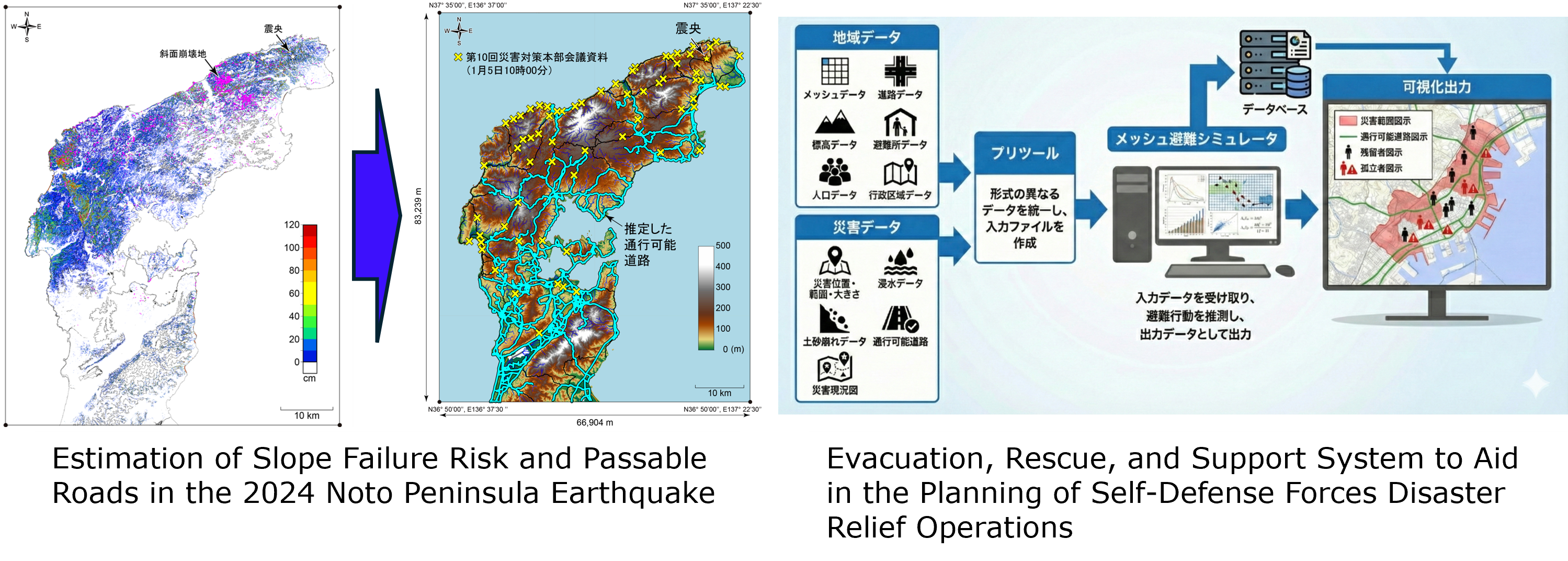
Japan’s topography creates a high risk of earthquake-triggered landslides, making rapid post-disaster damage assessment vital for saving lives. This research integrates "wide-area landslide hazard maps" into Japan Self-Defense Forces (JSDF) relief operations to accelerate initial response and establish safe, efficient troop deployment.
Optimizing Routes: Using hazard maps to estimate early road blockage risks enables initial plans that select safe detours or rapidly switch to air or sea transport.
Prioritizing Deployment: Overlaying landslide risk data with population density identifies isolated areas needing urgent rescue, guiding the concentrated deployment of limited personnel.
This allows preemptive, science-based deployment during the initial information vacuum, improving JSDF capabilities.
A Study on the Isolation and Buffering Performance of the Ground Surrounding Underground Shelter Facilities
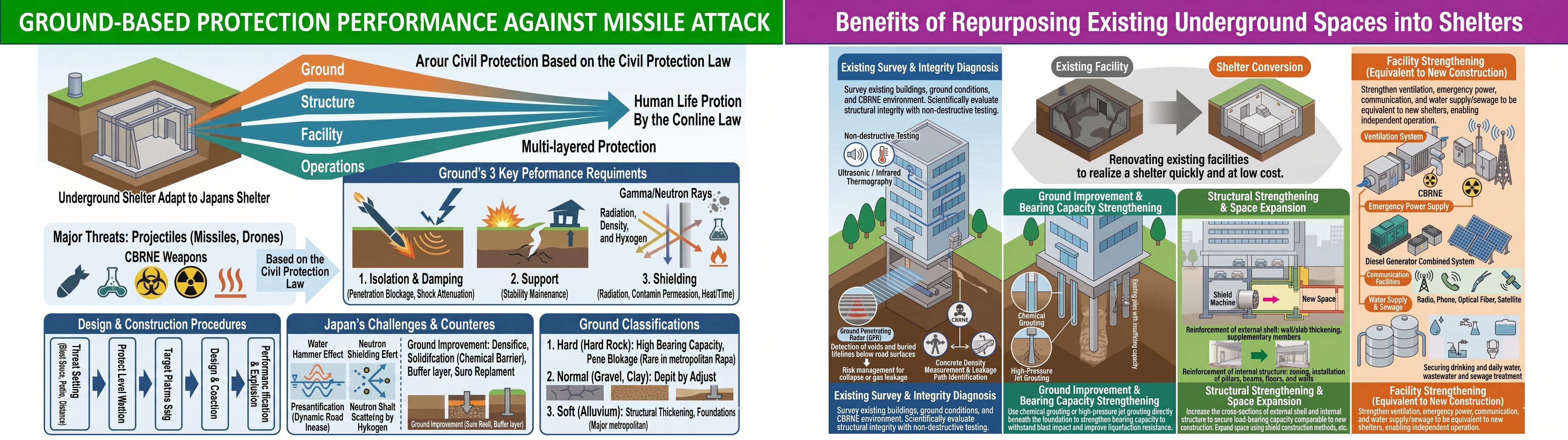
This study aims to elucidate the mechanisms by which surrounding soil absorbs and dissipates impact energy in order to protect underground shelters from physical threats such as explosions. To conduct this research, we will utilize the pneumatic impact loading tester and high-speed push-through shear tester owned by our laboratory to precisely evaluate the dynamic mechanical properties of soil materials at the element level under high strain rates. Furthermore, we possess a model testing facility equipped with a model of an underground shelter, which we use to empirically verify the protective performance of the entire system, including the dynamic interaction between the ground and the structure. Through a dual approach combining element-level testing and model experiments, we will present scientific insights that contribute to the formulation of technical standards for safe facilities and help enhance the resilience of the nation’s infrastructure.
Safety Assessment of Indoor Environments in Large-Scale Assembly Facilities Based on Human Tolerance
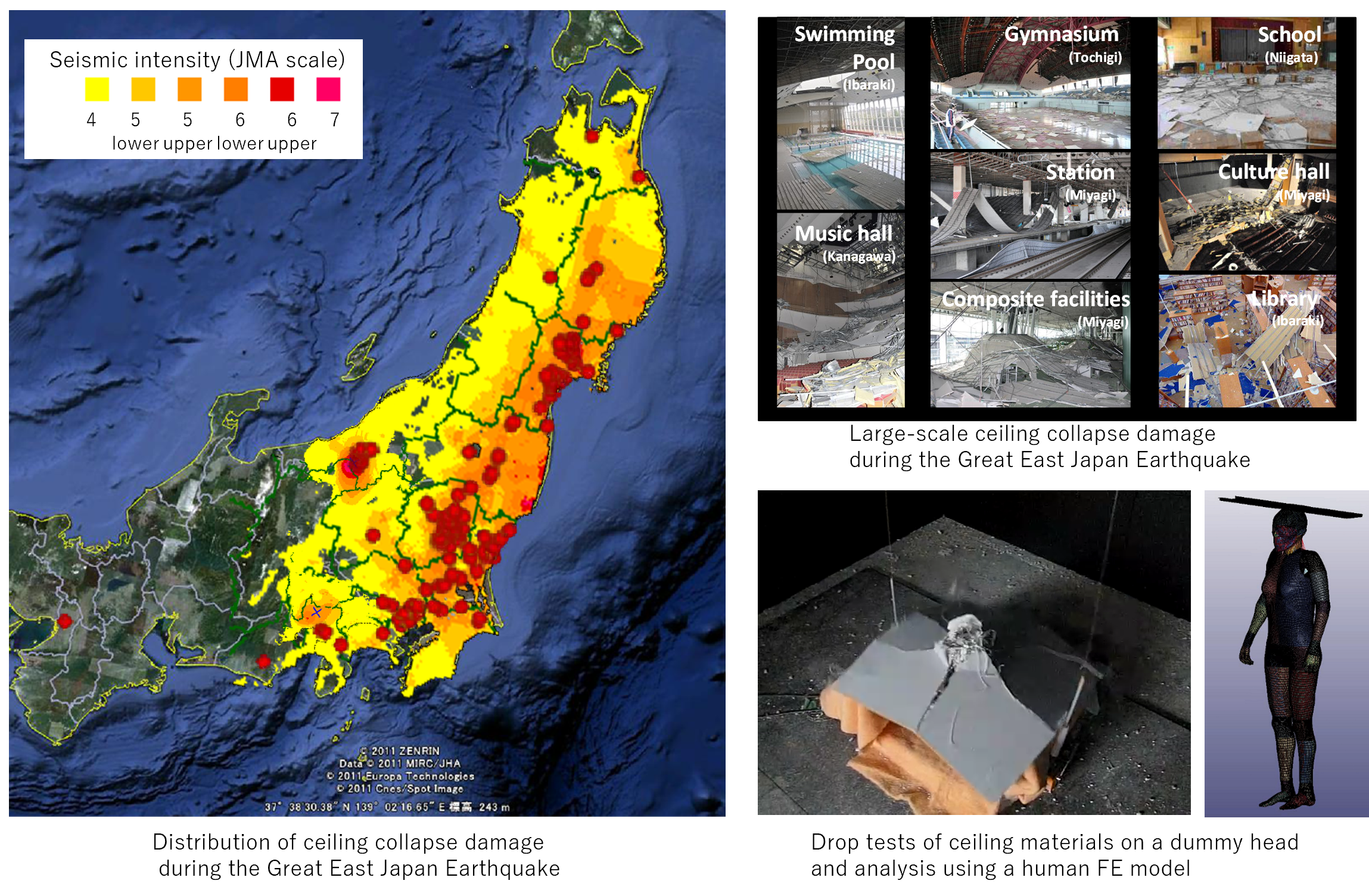
Have you ever paid attention to the ceiling above you? Ceilings play important roles in aesthetics, sound absorption, and thermal insulation, yet falling ceiling materials that injure people occur frequently worldwide. In particular, during earthquakes, such damage tends to occur at seismic intensities of around 5 lower or higher, often spreading simultaneously over wide areas and leading to large-scale disasters. This raises important questions: Are the ceilings above us truly safe, and what kinds of injuries would occur if they fell? To evaluate the safety of falling objects, this study uses a dummy head model from automotive crash testing and numerical human body models, conducting both experiments and analyses in an interdisciplinary framework spanning earthquake engineering, structural engineering, disaster prevention, human safety, and impact engineering.